Plantains: what are they and where do I get them?
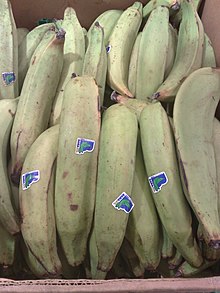
Like bananas, the color of the plantain's peel will give you a sense of ripeness. For bananas most people have a particular degree of green to yellow color in which they prefer the texture and sweetness. A banana is not truly ripe until the peel begins turning black but by that point it is usually too mushy to enjoy (although ripe for baking).
Plantains follow the same green to yellow to black path but they are used in different ways depending upon their ripeness. Green plantains are less sweet, firmer, and more starchy. These are used for savory dishes, like tostones. As they turn yellow they soften and become sweeter. At this point they are better for sweet dishes. Between green and yellow plantains there are a wide range of dishes prepared with virtually every cooking technique on the planet.
Green plantains are becoming more widely available in major supermarkets but you may need to source a Latin or world market with a produce section to find fresh plantains. In Texas they are available in several major chains although finding them vibrantly green is not always easy. For tostones I usually have to take what I can get, which often means they are starting to ripen. Tostones can be made with ripe, yellow plantains but these are often sweet preparations with powdered sugar or a cream-based sauce. For the savory tostones in this recipe, the greener the better. You can't get them too green.
Tostones technique: preparing and double frying
Tostones are easy to make but require double frying to develop a crispy, french fry-like crunch and to press them into the disk-like shape.
Double frying is a technique commonly used with high moisture vegetables but can be used for almost anything fried in oil to develop a crispier, less soggy texture. That includes fried chicken, french fries and deep fried desserts. What happens is when you fry, say french fries, you develop that nice outer crispy shell but the inside is moist. That's because the crispy shell locks in the moisture inside. The shell isn't very thick but it's thick enough to keep the moisture inside. When french fries cool they become soggy because the moisture eventually makes its way to the surface and makes that shell damp and sad. If you fry a second time you pull more moisture out and develop a thicker fried exterior. You could cook french fries longer but that usually results in hard, burnt fries.
With tostones double frying serves the purpose of developing a nice crispy shell but it serves a second purpose. It partially cooks the plantain which is necessary to mash it into a disk. Green plantains pre-cooking are hard and dense. You have to cook them a little first to soften them. Then you can mash and finish cooking. You could cut the plantain into thinner slices but without mashing them they will still be too dense to enjoy eating.
Smashing the plantain into tostones
There are two ways to smash the plantains after the first fry. One way is to use a tool made for that purpose: a tostonera. A tostonera (like this one) is a wood press that folds in half. I'm not a big fan of buying single use tools unless I really need them so I put other tools in the kitchen to work. After pulling the plantain out of the oil I let them rest on paper towels for a minute and then mash them by hand with the back of a wooden spatula. This is an easy process.
To smash the plantain by hand, stand the plantain slice upright on a not sticky surface, like aluminum foil. The oil on the surface of the plantain should keep it from sticking and you can peel the smashed plantain off the foil. Take the back of a flat wood (or metal) spatula and put it on top of the plantain slice. Then press down and away so you press at an angle, like you're pushing a stack of poker chips into the pot. If you press directly down you'll create a dense middle with thick, puffy sides. Instead you want a flat, even disk. If some of the plantain breaks away just gently push it back together. It doesn't have to look perfect, like a fairly even thickness. You can also do this with a vegetable can, pressing in the same method.
Quick note on serving quantity
Just a few things to suggest before getting into the recipe. This recipe is for two plantains which is usually just a little more than my wife and I will eat as a side dish. A plantain is a little larger than a normal russet potato. So consider those volumes ahead of time. Sometimes I'll buy a third plantain so we have leftovers. They don't microwave well (they turn soggy) but you can bake them for a few minutes to crisp them back up.
Tostones Recipe (Twice Fried Green Plantains)
Prep time: 10 minutes
Cook time: 20 minutes
Servings: 2-3
Equipment:
- Kitchen utensils
- Cutting board and knife
- Stovetop
- Medium to large saucepan, dutch oven or other vessel for frying
- Tostonera or wooden spatula
- Aluminum foil
- Paper towels
- Tongs or other utensil to remove tostones from oil
Ingredients:
- 3-4 cups canola oil (for frying)
- 2 green plantains
- Garlic salt
Directions:
- Heat oil in saucepan over medium to medium-high heat until it is 350F. Hold at this temperature once reached.
- Peel the plantains by cutting off the ends and cutting lengthwise down the peel. Peel off the peel and discard.
- Cut the plantain horizontally into 1.5 inch thick slices.
- Fry the plantains in the oil for 5-7 minutes, flipping over after 3 minutes, until the exterior is golden brown.
- Remove the plantains and place on paper towels to soak up excess oil (careful, the hot oil can burn)
- Press the plantains flat as described above
- Fry a second time for 5-7 minutes, flipping after 3 minutes, until golden brown
- Remove from oil to clean paper towels to absorb excess oil
- Sprinkle lightly with garlic salt
- Serve with pink sauce if desired
Pink sauce recipe
Pink sauce, also known as salsa rosada or salsa golf, is a popular condiment across South America and the Caribbean. It is seen often with seafood dishes but has a wide application. It's an easy recipe so there's almost no reason to buy it premade. It's equal parts ketchup and mayonnaise with a little garlic.
Seriously.
Basic recipe is 1/4 cup each of ketchup and mayonnaise with an 1/8th teaspoon of garlic powder or an equivalent of fresh garlic. Fresh garlic is a nicer taste but the garlic powder gives better consistency so I opt for powder. Stir until an even pink color and let it rest. That's it--but there is an important time issue.
If you taste the pink sauce right away it tastes like ketchup and mayo. Not very good. It needs to rest for a while to blend into the flavor of pink sauce. A couple hours is good but overnight is better. For whatever reason, the flavor changes from not good to great.
On the garlic I suggest going light at first. After the pink sauce rests you can taste and add a little more garlic if you want. It should be lightly garlicky. It's easier to integrate more garlic than take it away. If you let the sauce sit overnight you can taste in the morning and add more garlic if necessary. If you over-garlic, add more ketchup and mayo in equal portions.
If you end up with excess sauce after eating the tostones the sauce will stay good in the fridge and works in sandwiches, french fries, vegetables, etc.
